






Yes, you can bring your own food on a domestic flight in Australia. Solid food goes through security without any trouble, so sandwiches, fruit, muesli bars and packaged snacks are all fine in your carry-on. Better still, domestic flights are not subject to the 100ml liquid rule that applies to international travel, which means soup, yoghurt, dips and sauces can come along too.
There is one thing that trips travellers up, and it has nothing to do with airport security. It is biosecurity. Australia runs strict quarantine rules to stop pests like fruit fly spreading between regions, and that can stop you from carrying fresh fruit and vegetables into certain states. Here is the full picture, including what to leave at home.
What gets through airport security
On a domestic flight, the screening point is far more relaxed about food than most people expect. Any food that counts as a solid is allowed in your carry-on. That covers the obvious snacks plus a fully-packed meal if you would rather not buy on board.
Aerosols, like a can of whipped cream, are allowed but must have a fitted cap and be presented separately at the screening point. Organic powders such as protein powder, coffee or baby formula are not restricted domestically, though screening staff may ask to see them on their own. None of this applies the way it does internationally, where tighter limits kick in.
Can I bring liquids, yoghurt or soup?
On a domestic flight within Australia, yes. Flights within Australia are not subject to restrictions on how much liquid, aerosol or gel you can carry on board. The 100ml-per-container rule that catches people out applies to international flights only, not to a Sydney to Perth or Brisbane to Melbourne hop.
So a yoghurt, a thermos of soup, a tub of dip or a smoothie are all fine to take through a domestic screening point. If your trip connects onto an international flight, though, the international liquid limits apply from that point, so eat or bin anything over 100ml before you transfer.
What about alcohol?
You can carry alcohol on a domestic flight, with a couple of rules. In your carry-on, it must be in unopened containers. You can also pack it in checked luggage within reason. The one that surprises people: you are not allowed to drink your own alcohol on the flight. Only drinks bought from the airline’s onboard service may be consumed in the air.
If you have bought duty-free alcohol on a connecting international leg, keep it in the sealed tamper-evident bag with the receipt so it clears screening.
The real catch: flying food between states
This is where a packed lunch can land you a fine. Australia controls the movement of fresh produce between states and into certain zones to keep pests such as Queensland fruit fly and Mediterranean fruit fly contained. Fruit fly lives in the eastern states and the Northern Territory, but not in South Australia, Western Australia or Tasmania, which is exactly why those places guard their borders hard.
South Australia
South Australia takes a zero-tolerance approach. Fresh fruit and fruiting vegetables, including capsicum, chilli, tomato and eggplant, cannot be brought into the state or the Riverland without a plant health certificate. A shop receipt does not get you through. Get caught with restricted produce, and you can be fined.
Western Australia, Tasmania and the NT
Western Australia restricts produce to keep the Mediterranean fruit fly in check. Tasmania runs plant and animal quarantine checks at its airports and ferry terminals, with on-the-spot fines for anything you should not be carrying. The Northern Territory has its own zones, including restrictions around Alice Springs and along the Stuart Highway. The simplest rule of thumb: do not pack fresh fruit or vegetables to carry across a state border, and if in doubt, eat it or use a disposal bin before you fly.
Most domestic airports have quarantine disposal bins near the gates. If you are flying into SA, WA, Tasmania or an NT zone, bin fresh fruit and veg before you board rather than risk a fine.
If you want the details for your exact route, the Australian Interstate Quarantine traveller’s guide and the state agriculture departments are the authorities. South Australia even runs a Fruit Fly Hotline on 1300 666 010.
Smart food to pack, and what to skip

- Good picks: sandwiches and wraps, muesli bars, nuts, crackers, hard cheese, biscuits and packaged snacks. They travel well and survive a bag.
- Think twice: soft fruit like a banana or avocado that squashes, and anything with a strong smell. Kimchi, durian and heavily spiced dishes are legal, but your neighbours will not thank you.
- Leave behind for interstate routes: fresh fruit and fruiting vegetables if you are flying into SA, WA, Tasmania or an NT quarantine zone.
- Bring an empty bottle: there is no domestic liquid limit, but a refillable bottle filled after security saves buying water airside.
Frequently Asked Questions
Can I take a water bottle through domestic security in Australia?
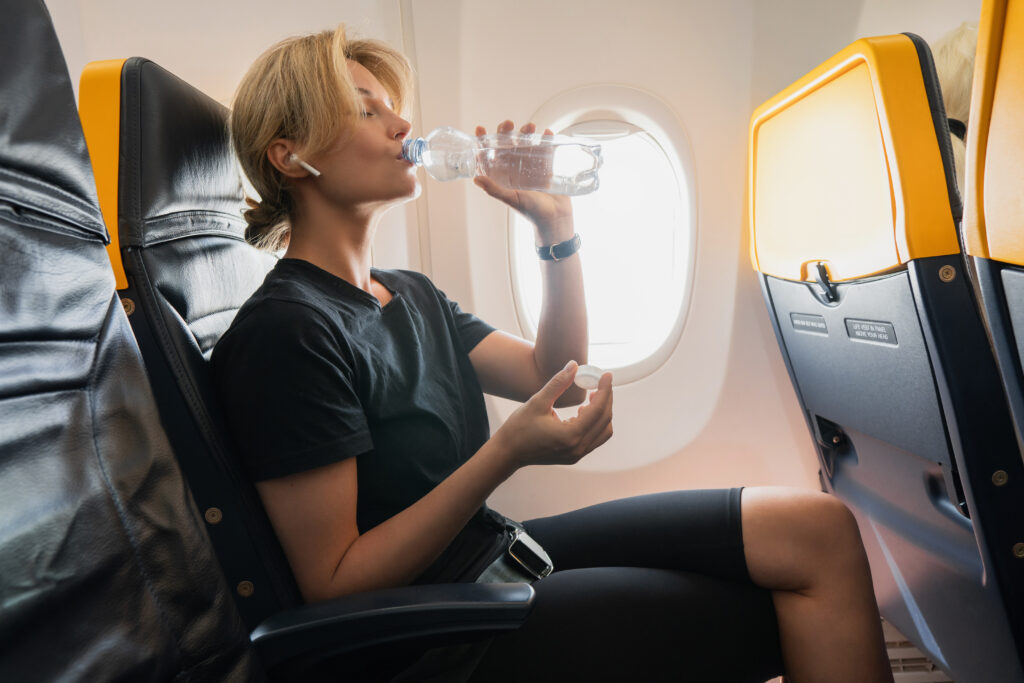
Yes. Domestic flights have no liquid limit, so a filled water bottle is fine through screening, and a metal bottle is allowed in both carry-on and checked bags. Just make sure the lid is sealed. If you would rather travel light through the checkpoint, take an empty bottle and fill it at a fountain airside.
Can I bring hot food or takeaway on a domestic flight?
Yes. Hot takeaway, a burger, hot chips or a curry are all allowed through domestic security and on board. The only real considerations are smell and spillage, so go easy on anything pungent out of courtesy to other passengers, and pack saucy items so they do not leak in the cabin.
Can I bring baby food and formula on a domestic flight?
Yes. Baby food, milk and formula are allowed, and domestic flights have no liquid limit, so quantity is not an issue. Powdered formula is also fine, though screening staff may ask to see powders separately. Pack what your baby needs for the trip and a little extra for delays.
Why can’t I take fruit on some domestic flights?
It is biosecurity, not security. Several states and zones, especially South Australia, Western Australia and Tasmania, ban incoming fresh fruit and vegetables to keep fruit fly out. The fine applies even if you bought the fruit legally elsewhere, because a receipt does not exempt restricted produce. When flying into those areas, leave fresh produce behind.
Planning group or private travel where the catering is yours to set? Talk to Air Charter Network on 1300 850 747 or request a quote online.
About the Author
The Air Charter Network team arranges private and group charter flights across Australia and worldwide. This article is general guidance only; always check current airline and state biosecurity rules before you fly.